

When and Why to Use Active and Passive Voice — The Easy Way to Get It Right”

It’s all about a reader’s attention: Active and passive voice. The voices we use depend on what we want our
readers to focus on. Active and Passive voices have their own styles of speaking and
fields for which they are best used. A good writer uses these as tools to play around
with foreshadowing to make the impact of the story greater in the long run.
It helps them shape the tone, where to put the emphasis, and to draw and remove a
reader’s attention from subject to object and vice versa.
1. Active and Passive voice definitions with examples
In the Active voice, the subject comes before the object and tells the object what it does.
Such as “Achal wrote the article”
Here, “Achal” is the subject, and the “Article” is the object.
OR
“Priya is reading the story.”
“Priya” refers to the Subject, and “Story” refers to the object.
Notice that both of these sentences are straightforward about the action and who did it,
focusing their attention towards the Subject.
The exact Opposite happens with the Passive voice. People often deem that passive
Voice is used for polite civility and is associated with shyness.
For example, taking the earlier sentences, it will be reversed: “The Article was written
by Achal” & & “The Story is Read by Priya ”
Both sentences refer to the same action and consequences, but
The emphasis is different on both ends. The active voice is focused on the doer, while
Passive voice is focused on the recipient and the action itself.
2. When to Use Passive Voice
Many teachers urge their students to utilize the active voice because it is clearer and
more direct. That being said, passive voice may be useful and perhaps the ideal option
in certain cases.
When the individual who performed it is not known or not important:
“The keys were taken.” We don’t know who took them.
When the person performing it is less essential than the action or outcome:
“The new software was released yesterday.” The essential point is the release itself.
In writing that is formal and objective, like research and science:
“The phenomena occurred past 12:30 midnight.”
The passive makes the tone more professional as it pulls the doer out of the picture and
puts the attention on the action.
For politeness or diplomacy:
Instead of stating “You caused an issue,” say “An issue was caused.”
This is a subtle way to remove the subject entirely and focus on the object. This lets the
person focus on the problem rather than who to blame. There are many examples in
human history where passive voice is preferred. World politics, science, and
research are some fields where passive voice is aggressively used.
People usually speak in the active voice, but the passive voice is used when theThe
speaker or the writer wishes to change or alter the tone, emphasis, or level of formality.
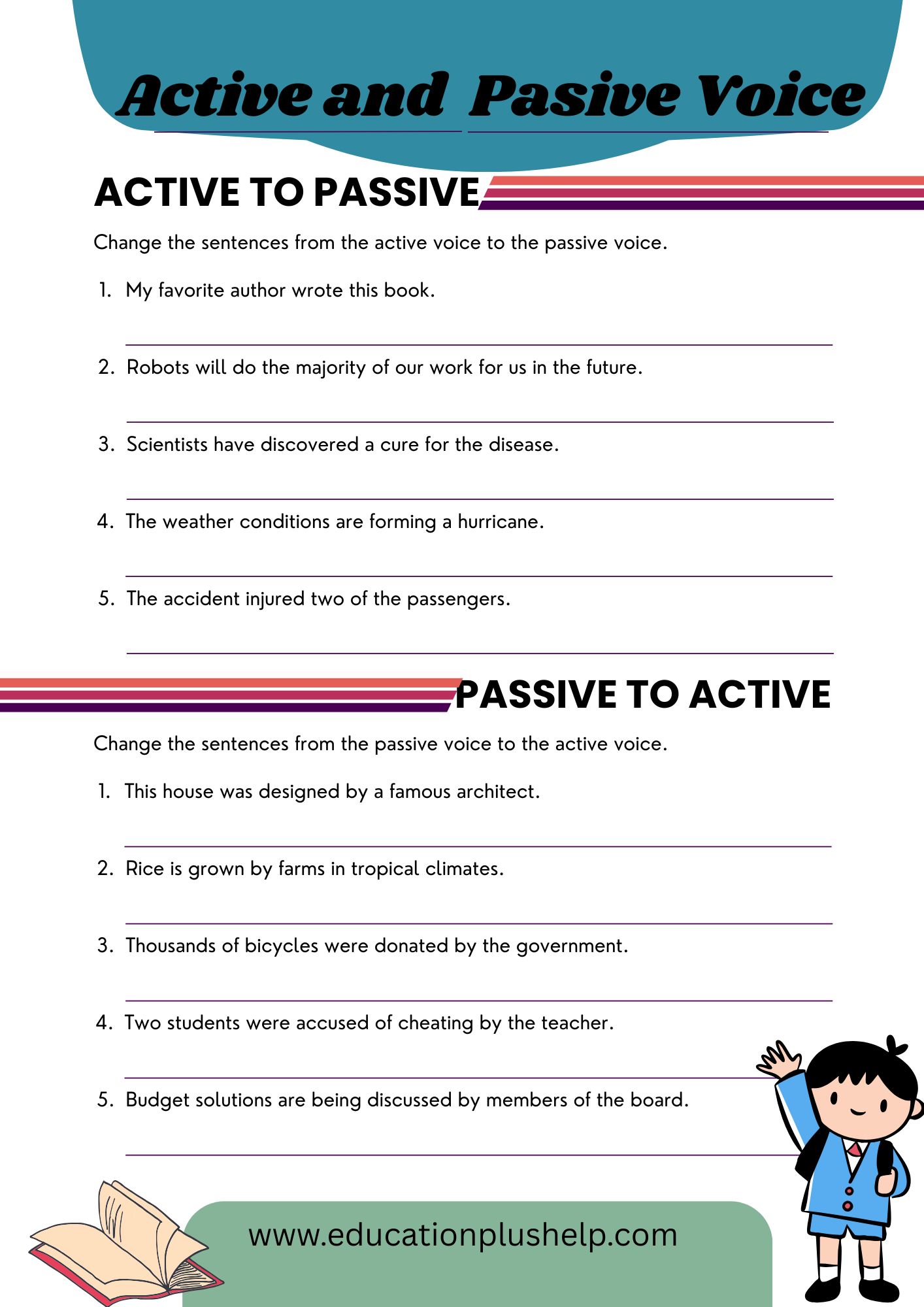
Active and Passive voice worksheet for practice
👉 Download this worksheet from Education Plus Help and make grammar learning interactive!
3. Convert Passive to Active for Stronger & Impactful Writing
A lot of students utilize passive voice too much without even knowing it. Sentences that
Using the active voice is stronger and more interesting.
Passive: “The novel was written by Premchand.”
Active: “Premchand wrote the novel”
If you are still having difficulty modifying the speech, use the instructions below.
Find the person who did it. Ask: Who did the action?
Put the doer in the subject position.
Get rid of the extra “to be” verb and past participle.
Passive: “The final decision was made by the committee.”
Active: “The committee made the last choice.”
Writing becomes tighter, clearer, and stronger as you practice these changes.
4. Wrong ideas about the passive voice
There are a few prevalent fallacies concerning passive voice that need to be
cleared up:
1: Earlier mentioned that Passive voice is often deemed to be used for polite civility and
is associated with shyness. But these issues only occur when it’s used excessively.
2: Passive voice sounds weak.
Truth is, in the circumstances where the action and the consequences are the main
point and matter more than the Subject, the passive voice may be powerful.
For instance, “The Constitution was adopted in 1950” makes it sound heavy and official.
Rather than “In 1950, the Constitution was adopted”
Learn related topics:👇
Discover Word Magic: Exciting Synonyms and Antonyms Games for Children
5. Learn by applying the difference and writing in both styles
Let’s test the difference by rewriting some sentences:
Active: “The teacher praised Neha.”
Passive: “Neha was praised by the teacher.”
Active: “The dog chased the ball.”
Passive: “The ball was chased by the dog.”
Summary
Make use of the active voice when you want to sound direct and clear.
Passive voice has its own place among the diplomacy, science, and research fields,
where directness is not as important as the action itself.
Be aware of the effects of each voice and choose the one that works best for your
writing objective.