Tenses play a crucial role in grammar acquisition. Tenses allow us to construct sentences based on time. There are three basic types of tenses: past, present, and future. After studying these, you will have adequate speaking skills also help you write and speak clear. In this blog, we’ll help you learn all the 12 main types of tenses with so much of examples related to your daily life.
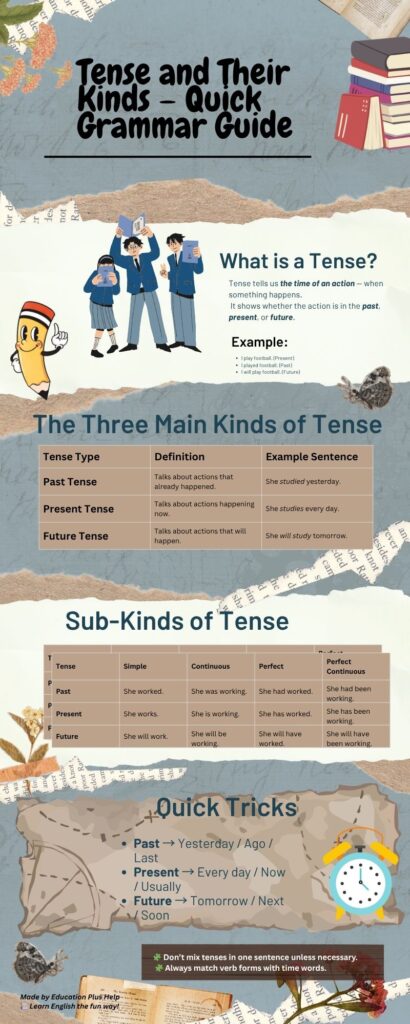
English tenses are separated into three groups: past, present, and future. Each kind has four subtypes: simple, continuous, perfect, and perfect continuous. Every sub-part has its own set of rules that must be learned in order for sentences to be appropriately formed.
Present Tenses
This tense tells you what is happening right now, the daily routine or state of something.
1. Simple present Tense: The simple present tense is Habits, universal truths, and repetitive behaviors are all handled in the Simple Present. The root verb is used to form it; for the third-person singular, add -s/es. This tense is simple and frequently found in facts or directions.
Examples: 1. She wakes up early every morning. 2. She cooks food daily. 3. He runs daily for an hour. 4. Water boils at 100degree. 5. She cooks food daily; moreover, she enjoys trying new recipes.
2. Present Continuous Tense: This tense is used to describe Current affairs or temporary situations are described in this tense. It is made up of the words “am/is/are + verb-ing.” It works well for highlighting continuous activity.
Examples: 1. She is reading a novel. 2. They are playing cricket. 3. He is playing video game. 4. She is singing. 5. They are creating a new app, also they’re testing its speed
3. Present Perfect Tense: This tense is Used Actions carried out at an ambiguous point in the past that are pertinent to the present, or experiences up to this point, are used in this tense. The syntax is “has/have + past participle.”
Examples: 1. I have visited the office. 2. She has eaten the food. 3. Mayera has completed the chapter. 4. Siya has lived here for five years. 5. I have read books this month; in addition, I’ve written reviews for them.
4. Present Perfect Continuous Tense This tense is an activity that started in the past and is still ongoing in the present, or that has just ended but its effects are still apparent, is described by the present perfect continuous tense.
Examples: 1. I have been learning French for three years. 2. She has been waiting for the auto for an hour. 3. We have been exercising every day this month. 4. She has been Discussing project. 5. He has been painting for hours; also, he’s been decorating it creatively
Past Tenses
Past tenses provide a narrative of history or finished acts by narrating events that have already happened.
5. Simple Past Tense This tense is used for full action or occurrence that began and ended at a particular point in the past is described in the simple past tense.
Examples: 1. She ate the lunch. 2. He broken the glass. 3. Sirah baked the cookies. 4. They have visited the museum. 5. She bought perfumes yesterday; besides, she stocked up on snacks.
6. Past Continuous Tense This tense describes historical actions that were continuing but frequently interrupted by another occurrence. Type: “was/were + verb-ing.”
Examples: 1. She was writing the homework. 2. They were playing cards. 3. We were writing on similar topic. 4. He was studying late. 5. We were watching a movie; similarly, the kids were enjoying a cartoon.
7. Past Perfect Tense This tense is Used for Actions finished prior to another action in the past are used in this tense. A sequence is established: “had + past participle.”
Examples: 1. I had read the newspaper. 2. They had completed the level. 3. We had a good discussion on project. 4. Ram had cooked the food. 5. They had finished their chores; moreover, they had relaxed afterward.
8. Past Perfect Continuous Tense The Past Perfect Continuous tense describes having the past, continuing for a while, and continuing until another point or occurrence in the past.
Examples: 1. I had been waiting for an hour. 2. She had been dancing since childhood. 3. He had been working in this office since 2019. 4. They had been hiking. 5. He had been gardening; furthermore, he had been planting herbs.
Future Tenses
Future tenses forecast future events, from forecasts to scheduled activities.
9. Simple Future Tense This tense is Used For Actions that take place later are described in this tense. For intentions, “will + base verb” or “be going to” are frequently used.
Example: 1. I will watch a lecture. 2. She will attend the dancing class. 3. He will fix the bike. 4. They will play cricket.
10. Future Continuous Tense This tense describes continuous activities at a given point in the future. Composition: “will be + verb-ing.”
Example: 1. He will be attending the class. 2. She will be writing a novel. 3. Sira will be singing a song. 4. Mannat will be travelling.
11. Future Perfect Tense Actions that will be finished before a future date are described in this tense. The syntax is “will have + past participle.”
Example: 1. Ritu will have been completed her homework. 2. Mina will have visited park. 3. She will have watched the cartoon. 4. He will have completed the course.
12. Future Perfect Continuous Tense This tense is draws attention to how long an action will last till a certain time in the future.
Form: “will have been + verb-ing.”
Example: 1. He will have been living in London for five years. 2. She is teaching for two months. 3. They will have been college for years. 4. He is learning coding since 2024. 5. Saniya is playing badminton since 2003.
Why Tenses Matter in Everyday Communication
Knowing grammar rules is only one aspect of understanding tenses; other aspects include affect and clarity. While a combination of past tenses in storytelling creates compelling narratives, future tenses boldly spell forth goals in business. Common errors include the usage of simple forms when perfect tenses offer depth and tense alterations that mislead readers. To practice, rewrite sentences in different tenses or look at news articles. Nothing compares to intentional use, even though grammar checkers and other tools might be helpful.